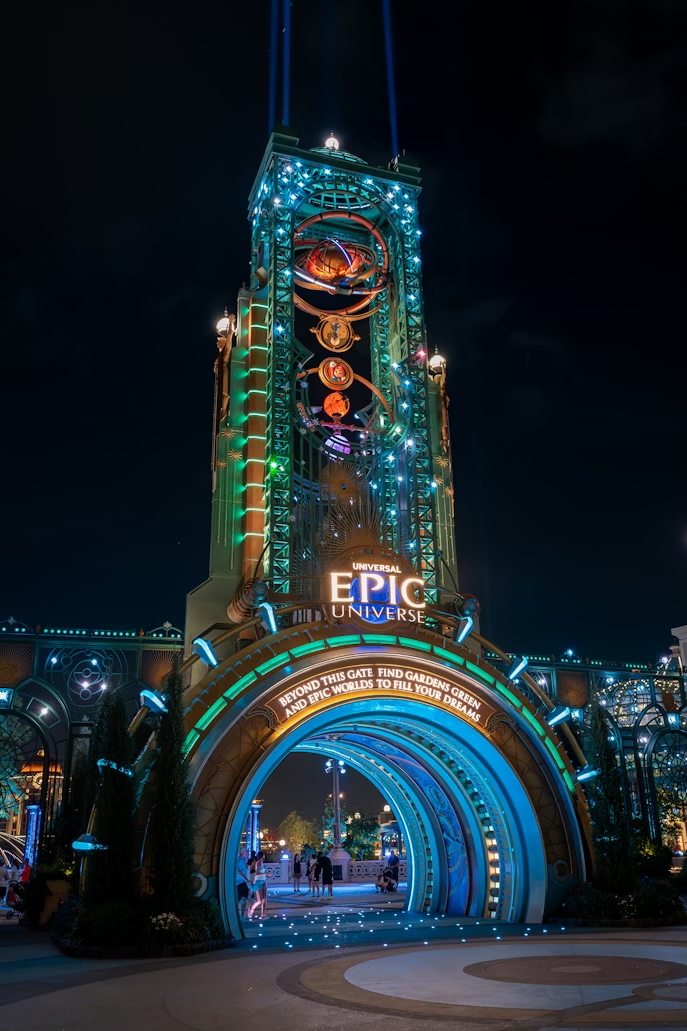
Since the opening of Epic Universe, there’s been a lot of speculation around what can best be described as “slots in the ground for tech” at the entrance to each portal. Some assumed they were simply for fencing used during park opening and closing. Others believed they were part of a larger plan—one that could allow guests without tickets into Celestial Park, the hub land that connects everything, while restricting access to the individual lands.
As of now, we’re starting to get a clearer picture. Universal has installed facial recognition kiosks at the entrances to some (if not all) of the portals leading into each land.
So what does this actually mean?
Before diving in, it’s worth noting that there are two strong theories circulating.
The first is what I’d call the “Celestial CityWalk” concept. In this scenario, Celestial Park would function similarly to CityWalk—you wouldn’t need theme park admission to enter the area, dine, or shop. However, you would need a ticket to access the individual lands, attractions like Constellation Carousel and Stardust Racers, and anything beyond the hub. Access would be managed through facial recognition and team members at each portal, similar to how entry is currently handled from Helios Grand Hotel.
The second theory is more operational—and arguably more interesting. This approach centers around events.
There’s ongoing construction at Epic Universe tied to a large, purpose-built event space. When we talk about “events,” think corporate buyouts, private gatherings, or smaller media and passholder experiences—not Halloween Horror Nights. (And to be clear: HHN is not moving to Epic Universe. The infrastructure simply isn’t there.)
The idea here is that Universal could reserve entire lands for private events. Imagine attending a corporate function where only your group has access to Super Nintendo World for the evening. It’s a premium experience, a massive revenue opportunity, and a powerful way to introduce new guests to the park.
And that’s where things get complicated.
Personally, I don’t love either of these ideas—but I understand why they exist.
Starting with the event angle, it’s easy to see the upside. Corporate events are big business, and they create a unique funnel for new visitors. Someone attends a private event, has an incredible experience, and suddenly they’re planning a return trip with their family.
The downside? If you’ve ever had to leave a park early or lost access to an area because of a private event, you know how frustrating it can be. Now imagine that happening at Epic Universe—a park that arguably shines brightest at night. Losing access to a land during those hours would be a tough pill to swallow.
So what about the “Celestial CityWalk” concept?
On paper, it makes a lot of sense.
If we’re being honest, most guests don’t spend a ton of time in Celestial Park. It’s beautiful, thoughtfully designed, and full of great dining—but it often feels like a place you pass through rather than a destination you linger in. I’m guilty of that myself.
But it’s also massive. On my last visit, I was surprised by how many pathways wind through the gardens and fountains. Add in the existing dining options—and the additional restaurants currently under construction—and you start to see the potential.
From a business perspective, this is about maximizing return on investment.
Epic Universe is one of the most expensive theme park projects ever built, and its costs only grew with pandemic delays, rising material costs, and inflation. At the same time, Universal is intentionally operating the park at reduced capacity to maintain a high-quality guest experience.
That creates a challenge: fewer guests means fewer ticket sales, fewer merchandise purchases, and fewer dining transactions.
Opening Celestial Park to non-ticketed guests could help offset that. More people in the hub means more food and beverage revenue, more retail spending, and more overall engagement—all without increasing ride wait times inside the lands.
It’s a smart business move.
But it comes with trade-offs.
For guests who paid full admission, it likely means a more crowded hub, longer waits for dining, and a different overall feel.
And then there’s the biggest potential loss: the nighttime experience.
Right now, the fountain show in Celestial Park is one of the best ways to end a day at Epic Universe. There’s plenty of space, plenty of seating, and none of the chaos you get trying to watch fireworks at Magic Kingdom. It’s calm. It’s accessible. It feels intentional.
If that space suddenly becomes open to anyone—especially with a potential fireworks show on the horizon—it’s hard not to imagine it becoming packed.
And once that happens, the experience changes.
So what’s next?
For now, it’s a waiting game.
Universal is constantly testing, iterating, and adjusting. These kiosks are just the latest example of that. Whether they lead to a CityWalk-style hub, expanded event offerings, or something else entirely remains to be seen.
— Mike Bundy, Park Brief


Leave a Reply